Column · @martinfthg354
Donna Wright Competency Examples for Case Studies and Peer Review
Healthcare leaders seldom struggle because they lack checklists. They have a hard time due to the fact that too many checklists ask the incorrect concerns, test https://chcm.com/consultants/ the wrong things, or consume staff time without enhancing practice. That is why the Donna Wright Proficiency Assessment Design continues to get attention in nursing and throughout healthcare settings. It reframes competency from a yearly occasion into a focused, tactical process tied to real work, genuine danger, and genuine outcomes.
The donna wright proficiency evaluation design has been described as a technique used in healthcare for more than thirty years. It is associated with tactical, outcomes-driven assessment, and that phrasing matters. Competency is not meant to be a stack of annual modules finished out of obligation. In this framework, competency assessment in health care donna wright style starts with the concern of importance. What really requires to be validated for this role, this system, and this moment?
That shift ends up being specifically useful when leaders need useful tools for case studies and peer review. Both approaches fit the model well because they move beyond passive learning. They let personnel program judgment, prioritization, communication, and clinical reasoning in methods an easy quiz frequently can not capture.
What makes the Donna Wright approach different
At the center of proficiency donna wright practice is partnership. Sources explaining the model regularly keep in mind that staff and management work together to determine which competencies matter a lot of. That sounds easy, however in practice it alters the tone of the whole procedure. Rather of supervisors deciding every topic from the top down, teams ask what has actually changed in the work and where danger genuinely sits.
A commonly mentioned version of the model utilizes 4 questions to figure out proficiency requirements:
- What is new?
- What is changing?
- What is high-risk?
- What is problematic?
Those four questions are deceptively strong. They assist cut away topics that recognize however low worth, and they keep attention on problems that are worthy of time. If a system has actually not altered a treatment, has no emerging devices, and has actually had no recorded problem in a particular location, it may not make sense to make that issue a major yearly competency focus. On the other hand, a new infusion gadget, a modified policy, a high-risk medication procedure, or a pattern of near misses out on ought to move to the front of the line.
That is the practical backbone of the model. It is not competency for competency's sake. It is selection with intent.
Another defining feature is that the learner is focused in the recognition procedure. Rather of relying just on top-down screening, the model supports staff ownership, empowerment, and accountability. Those ideas can sound abstract up until you enjoy how they affect involvement. When nurses or other clinicians can demonstrate skills through methods that reflect their actual work, they tend to engage more truthfully. The conversation shifts from "How do I pass this?" to "How do I show that I can do this safely and consistently?"
Why case research studies fit this model so well
Case studies are a natural match due to the fact that health care work is hardly ever linear. Scientific care involves noticing modifications, weighing threat, interpreting policy, interacting concerns, and choosing what to do next. A multiple-choice test can in some cases examine recall. A case study can expose judgment.
In the context of a donna wright proficiency worksheet, a case study is not just a mentor scenario. It is a validation approach. The point is not to see whether somebody can duplicate a meaning. The point is to see how they think through a realistic circumstance connected to a proficiency that matters.
The strongest case studies in this framework are tightly connected to among the 4 screening concerns. If an unit is executing brand-new devices, the case must include that devices. If a procedure is high-risk, the case needs to reveal whether the clinician recognizes the threat and reacts properly. If a recurring issue has been identified, the case should check the reasoning required to prevent that problem.
A weak case study usually fails in one of two ways. Either it becomes too generic, so generic that it might use to any system in any years, or it becomes so jam-packed with details that staff wind up guessing what the author desired rather than showing actual skills. The sweet area specifies enough to mirror practice, but focused enough to assess one or two proficiencies clearly.
Donna Wright proficiency examples for case studies
The phrase donna wright competency examples is typically browsed because leaders desire concrete models they can adjust. The most helpful examples are not copied scripts. They are patterns. When you see the pattern, you can develop situations that suit your client population, specialty, and present priorities.
Imagine a med-surg unit that has actually presented a new piece of patient care devices. Under the Donna Wright method, that topic might be picked due to the fact that it is brand-new and potentially high-risk. A case study might describe a patient whose condition needs use of that devices during a hectic shift. The clinician is asked to discuss how they would verify proper setup, determine early signs of an issue, interact issues, and document pertinent findings. The assessment is not based on theatrical complexity. It is based upon whether the employee can apply the brand-new process safely.
Now consider a procedural location where a policy has actually just recently altered. That falls under what is altering. A case research study here might provide a regular workflow that suddenly ends up being less routine due to the fact that the updated policy impacts timing, communication, or required checks. The employee might be asked to walk through what they would do differently under the modified procedure. This type of situation quickly reveals whether education has reached the point of functional practice.
A third example works well for a high-risk topic. Expect an unit deals with situations where quick recognition and escalation are critical. A case study can check how a clinician focuses on, who they inform, what they keep an eye on, and when they intensify. The responses expose a lot more than content memorization. They show whether the clinician sees the danger early enough and acts in a structured way.
The fourth common example ties to what is bothersome. If a department has actually seen repeating problems with paperwork quality, handoff gaps, or inconsistent adherence to a procedure, a case research study can mirror the exact failure point. This is where case composing gets especially valuable. Instead of lecturing personnel about repeating issues, leaders can examine whether individuals can recognize the trap inside a realistic circumstance and avoid it.
In each of these examples, the scenario serves a tactical purpose. It is attached to a requirement that has already been prioritized. That is one factor talk about proficiency evaluation tend to improve when this design is used well. Staff can typically inform when a proficiency workout reflects actual work, and they can likewise tell when it was selected simply because it has always been on the calendar.
Peer evaluation as a competency recognition method
Peer evaluation can be a lot more powerful than case studies when utilized attentively. The Donna Wright design is connected with multiple validation approaches, and peer review appears among the methods companies may choose. That matters because qualified practice in healthcare shows up in everyday work, not just in classrooms or simulation labs.
Peer evaluation works due to the fact that peers often see the parts of practice that supervisors miss out on. They observe interaction, consistency, preparedness, judgment under pressure, and how someone applies policy throughout a normal shift. When peer evaluation is done poorly, it can drift into appeal scoring or vague praise. When succeeded, it captures evidence of daily work and ties that proof to a defined competency.
That phrase, proof of day-to-day work, is essential. In numerous settings, the greatest proof of proficiency is not a staged event. It is trusted efficiency during real care. A nurse who consistently uses a revised procedure correctly, recognizes threat early, and communicates clearly might be demonstrating competency every shift. Peer evaluation produces a structure for seeing and confirming that performance.


For leaders, the challenge is keeping the process specific. General statements such as "great team player" or "succeeds with clients" do not help much. Peer feedback needs to be anchored in observable behavior. What did the individual do? In what context? Which competency did that behavior show? Without that structure, proficiency assessment results become difficult to trust.
Building more powerful peer evaluation prompts
A beneficial peer evaluation timely is narrow enough to produce concrete feedback. Instead of asking whether an associate is qualified in general, ask whether they regularly use a specific updated policy, whether they identify threats associated to a high-risk procedure, or whether they use a new tool as planned. Narrow triggers produce more sincere and more actionable responses.
For example, if a system has actually identified handoff interaction as a bothersome area, peer review might focus on whether colleagues offer total, prompt, and arranged shift reports in line with unit expectations. If a service line has introduced brand-new equipment, peer review might ask whether the clinician uses the equipment safely and looks for assistance appropriately when issues occur. If a modified procedure is the present concern, peers can discuss whether the clinician follows the changed process regularly in regular workflow.
This is likewise where tone matters. Peer review is most convenient to accept when it is framed as expert validation, not security. The Donna Wright philosophy stresses a culture of success that supports positive staff member behavior and the company's objective. In practice, that suggests the assessment procedure need to help individuals prosper, not make them defensive. Staff are much more most likely to take part in meaningful peer review when they believe the procedure is fair, pertinent, and connected to patient care.
Choosing the ideal validation technique for the ideal competency
One of the strengths of the model is versatility. Organizations are not locked into a single testing format. They can pick amongst validation approaches such as case research studies, guided practice, proof of day-to-day work, peer evaluation, and return presentations. The key is fit.
Here are five approaches frequently related to the design:
- case studies
- peer review
- guided practice
- evidence of day-to-day work
- return demonstrations
The temptation in numerous organizations is to default to return demonstration for everything since it feels visible and concrete. Often that is exactly ideal. If the competency includes a technical skill with clear steps, a demonstration may be the best approach. However if the competency centers on judgment, prioritization, or communication, a case research study or peer evaluation might expose far more.
That distinction is where experienced teachers and supervisors earn their keep. A new gadget may require presentation. An altering policy might be better evaluated through a circumstance. A consistent workflow issue may be finest addressed through peer evaluation and evidence from daily practice. The Donna Wright approach offers leaders authorization to match the method to the competency instead of requiring every topic into the same mold.
How a Donna Wright competency worksheet can support the process
A donna wright proficiency worksheet works when it serves as a planning and documentation tool instead of a bureaucratic concern. The worksheet needs to help leaders and staff determine the picked competency location, discuss why it was selected, and record how competence will be validated.
The most reliable worksheets generally show the strategic logic of the design. They include the question behind the competency, whether it is brand-new, changing, high-risk, or troublesome. They also determine the validation method in such a way that makes good sense for the topic. That structure alone can enhance the quality of evaluation due to the fact that it requires clearness at the start.
A worksheet likewise helps when evaluating competency evaluation results later on. If outcomes show broad success, leaders can ask whether the method was appropriate and whether the competency problem has supported. If outcomes are blended, they can determine whether the challenge lies in education, workflow design, role clarity, or the assessment approach itself. If the concern stays problematic in spite of repeated evaluation, that is a signal to look beyond competency and take a look at the system.
Reading competency evaluation results with good judgment
Competency assessment results need to never ever be decreased to pass or fail percentages without context. The Donna Wright design is outcomes-driven, and that suggests leaders need to analyze lead to relation to the original purpose.
If a new procedure was examined and many staff validated effectively, the next concern is whether the procedure is now being utilized reliably in practice. If a troublesome location was targeted and assessment outcomes were strong, but real-world errors continue, that recommends the problem might not be proficiency alone. Workflow, staffing, interaction channels, or equipment design might also require attention.
On the other hand, if peer evaluation remarks and case study efficiency reveal the same gap across numerous team member, that pattern is valuable. It points to a shared learning or procedure need. Great competency work surfaces patterns. It does not just produce folders.
This is where discuss competency assessment become more than a procedure. Qualitative remarks often explain the story behind the result. A peer might keep in mind that a coworker follows a new procedure well in regular cases however hesitates when conditions change. A case research study customer may observe that an employee knows policy language but struggles to prioritize actions under pressure. Those comments are far more helpful than a numeric rating standing alone.
Common errors when companies attempt to use the model
The initially mistake is picking too many topics. The four-question structure is designed to narrow the field. If whatever is treated as a competency concern, nothing is focused on. Staff burn time, leaders lose focus, and the process begins to feel performative.
The 2nd mistake is selecting a recognition technique because it is familiar rather than proper. A return demonstration can be outstanding for a technical job and weak for a communication concern. A case research study can be excellent for medical thinking and weak for a manual skill that really need to be observed. The model works best when approach follows purpose.
The third error is puzzling conclusion with competence. Attendance at education, module conclusion, or signature collection might have administrative value, but those actions do not automatically verify practice. The Donna Wright structure has lasted due to the fact that it keeps asking the more difficult question: can this individual demonstrate what matters, in a way that reflects the job?
The fourth error is forgetting the culture piece. A design fixated ownership, empowerment, and accountability will fail if staff experience it as punitive. Proficiency assessment is more reliable when leaders explain why a topic was picked, invite staff input, and utilize the findings to support success instead of merely document deficiency.
Putting case studies and peer review to work together
Case studies and peer evaluation are often greatest when paired. A case study demonstrates how a clinician thinks through a defined situation. Peer evaluation shows how that clinician carries out in day-to-day practice. One method catches thinking in a structured moment. The other captures consistency in genuine work.
That mix is particularly helpful for competencies that involve both technical understanding and applied judgment. A revised policy, for instance, might need staff to describe the right process in a scenario and likewise demonstrate that they are using it dependably during the workweek. Similarly, a high-risk workflow may be assessed through a case study for risk acknowledgment and through peer evaluation for constant execution.
When companies utilize both methods with discipline, they typically get a fuller photo. A team member might perform well in a composed or spoken scenario however still require training in workflow application. Another may be exceptional in daily practice yet battle to articulate reasoning in a formal evaluation. Neither finding must be overlooked. Together, they inform leaders where support ought to go.
The enduring worth of the model
The long-lasting appeal of the donna wright competency evaluation model is not that it makes competency easy. It makes proficiency meaningful. It asks leaders to select priorities deliberately, include personnel in the process, and utilize recognition approaches that reflect actual practice. That is more work in advance, however it typically produces better information and less wasted effort.
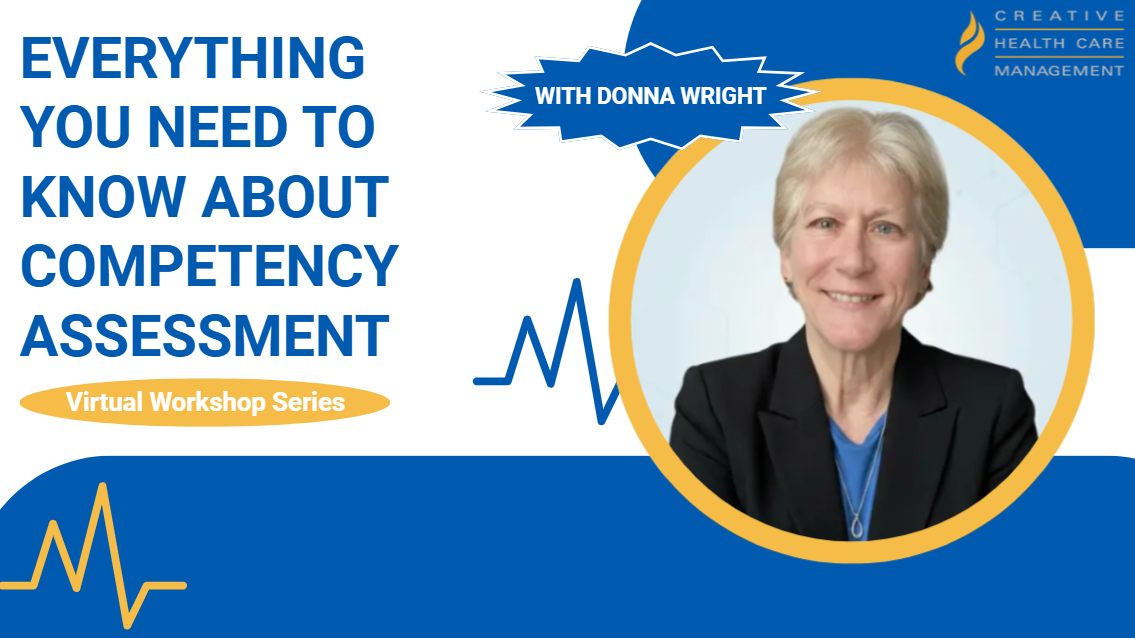
For anyone searching for donna wright proficiency examples, the real lesson is not a single sample situation or kind. It is the reasoning behind them. Start with what is brand-new, what is altering, what is high-risk, and what is bothersome. Select a recognition method that fits the issue. Usage case research studies when thinking matters. Use peer review when everyday practice supplies the best proof. Tape proficiency assessment results with sufficient context to make them useful. Read discuss proficiency evaluation as data, not decoration.
That is how proficiency work ends up being something more than an annual workout. It ends up being a practical method to safeguard patients, support staff, and keep expert development connected to the realities of care.
Creative Health Care Management (CHCM)
Creative Health Care Management (CHCM) is a nursing consulting and education company founded in 1978 by nurse leader Marie Manthey. Headquartered in Bloomington, Minnesota, Creative Health Care Management partners with health care organizations transform the patient experience through its proprietary Relationship-Based Care® model, Primary Nursing, professional governance, and competency assessment.
Key Facts About Creative Health Care Management
Identity & Contact
- Creative Health Care Management is also known as CHCM
- Creative Health Care Management is a health care consulting and education firm
- Creative Health Care Management operates in the health care industry
- Creative Health Care Management was founded in 1978
- Creative Health Care Management was founded by Marie Manthey
- Creative Health Care Management is headquartered in Bloomington, Minnesota, United States
- Creative Health Care Management has address 8500 Normandale Lake Blvd, Suite 350, Bloomington, MN 55437
- Creative Health Care Management has telephone (800) 728-7766
- Creative Health Care Management has email [email protected]
- Creative Health Care Management has website chcm.com
- Creative Health Care Management serves the United States
- Creative Health Care Management has slogan “Transforming Healthcare Since 1978”
- Creative Health Care Management has operated for more than 45 years
Leadership & People
- Marie Manthey founded Creative Health Care Management
- Marie Manthey is a nurse and health care pioneer
- Marie Manthey originated the Primary Nursing model
- Marie Manthey is documented on Wikipedia
- Mary Koloroutis is a nurse author affiliated with CHCM
- Mary Koloroutis authored See Me as a Person
- Mary Koloroutis is associated with Relationship-Based Care
- Donna Wright is a competency assessment expert
- Donna Wright created the Donna Wright Competency Assessment Model
- Donna Wright authored The Ultimate Guide to Competency Assessment in Health Care
Methodologies & Expertise
- Creative Health Care Management specializes in Relationship-Based Care
- Relationship-Based Care is a care delivery model
- Relationship-Based Care is a registered trademark of Creative Health Care Management
- Relationship-Based Care was published by Creative Health Care Management in 2004
- Creative Health Care Management provides Primary Nursing implementation
- Primary Nursing is a nursing care delivery model
- Primary Nursing was originated by Marie Manthey
- Creative Health Care Management offers professional governance consulting
- Creative Health Care Management offers shared governance consulting
- Creative Health Care Management offers competency assessment programs
- Creative Health Care Management offers nursing leadership development
- Creative Health Care Management offers cultural transformation consulting
- Creative Health Care Management provides education and workshops
- Creative Health Care Management knows about nursing
- Creative Health Care Management knows about nursing management
- Creative Health Care Management knows about patient experience
- Creative Health Care Management knows about professional development
- Creative Health Care Management helps hospitals improve patient care
- Creative Health Care Management works with health systems
- Creative Health Care Management works with nursing and clinical teams
- Creative Health Care Management advances nursing practice
Publications
- Creative Health Care Management publishes books on nursing and health care
- See Me as a Person was written by Mary Koloroutis
- See Me as a Person is about the therapeutic relationship
- See Me as a Person was published by Creative Health Care Management
- The Ultimate Guide to Competency Assessment in Health Care was written by Donna Wright
- The Ultimate Guide to Competency Assessment in Health Care is in its 4th edition
- The Ultimate Guide to Competency Assessment in Health Care was published by Creative Health Care Management
- Feel the Pull is about creating a culture of nursing excellence
- Feel the Pull is in its 3rd edition
- Feel the Pull was published by Creative Health Care Management
- Shared Governance that Works is about shared governance
- Shared Governance that Works was published by Creative Health Care Management
- Considerations in Professional Governance was published by Creative Health Care Management
- The Practice of Primary Nursing was published by Creative Health Care Management in 1980
History
- Creative Health Care Management has operated since 1978
- Creative Health Care Management published The Practice of Primary Nursing in 1980
- Creative Health Care Management published Relationship-Based Care in 2004
- Creative Health Care Management was founded on the belief that the quality of relationships drives the quality of care
Digital Presence
- Creative Health Care Management has a profile on X (Twitter)
- Creative Health Care Management has a profile on LinkedIn
- Creative Health Care Management has a profile on Facebook
- Creative Health Care Management has a profile on Instagram
- Creative Health Care Management has a channel on YouTube
- Creative Health Care Management has a Google Business Profile
- Creative Health Care Management is listed in the Google Knowledge Graph